Is SEO Dead in 2026? Here’s What Is Actually Changing
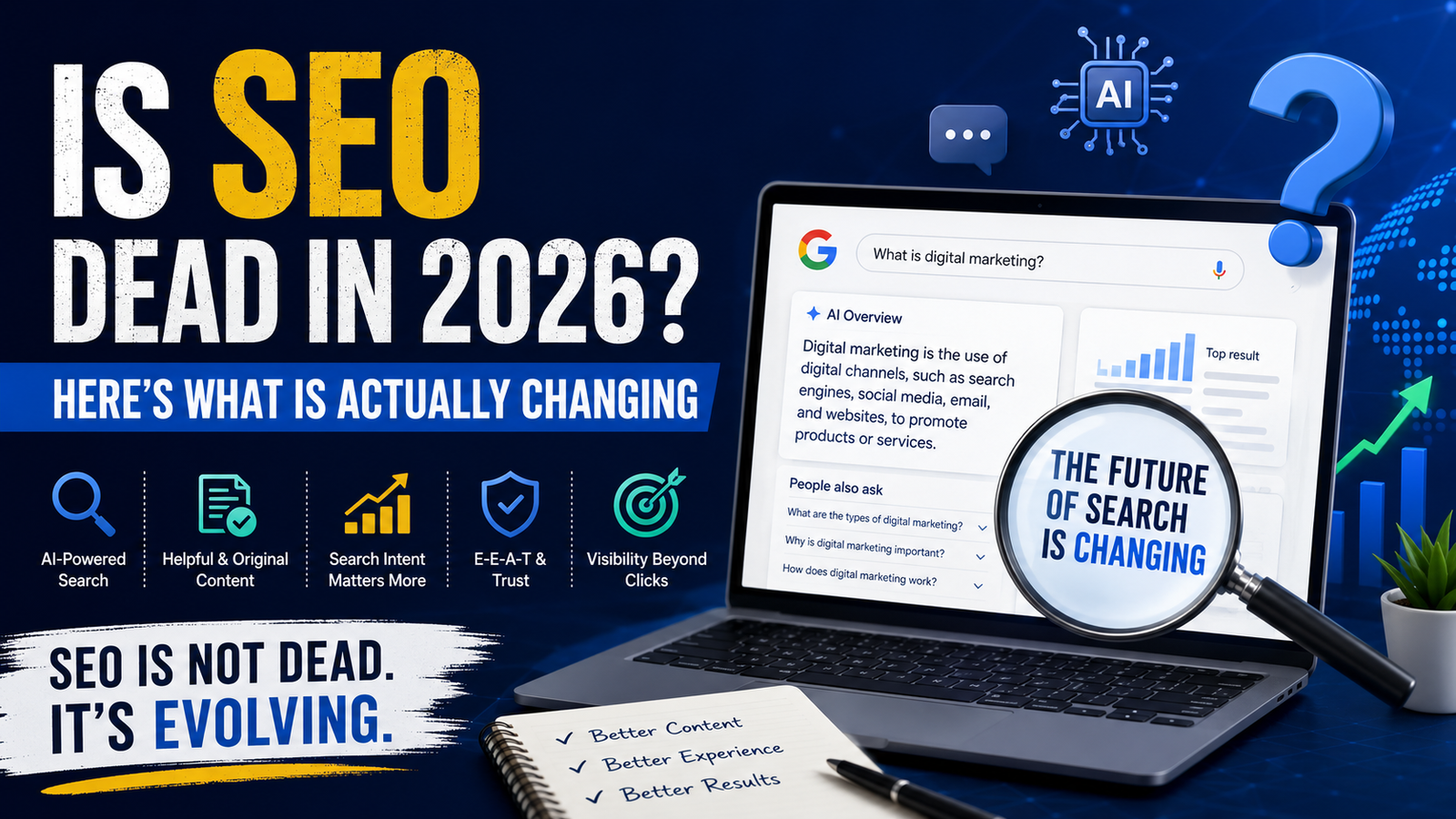
Table of Contents
Introduction
If you work in digital marketing, you may have heard one question many times: Is SEO dead in 2026?
The short answer is no, SEO is not dead. But the way SEO works is changing.
Earlier, SEO was mainly about choosing keywords, creating backlinks, optimizing pages, and ranking higher on Google. These things are still important, but search is now becoming more focused on AI-generated answers, user intent, helpful content, and overall search visibility.
Google is now using AI features such as AI Overviews and AI Mode to help users find information in a more conversational way. Google has also published new guidance explaining that traditional SEO best practices remain important for appearing in these generative AI search features.
This means businesses should not stop doing SEO. Instead, they need to understand how search is changing and update their SEO strategy.
In this blog, we will understand what is changing in SEO in 2026 and how you can prepare your website for the future of search.
Summary
SEO is not disappearing in 2026. It is evolving.
Search engines are using AI to understand queries, content, and user intent better. Users can now get direct answers through AI Overviews and other search features without always visiting a website.
Because of this, SEO is moving from only focusing on rankings and clicks to focusing on visibility, authority, useful content, brand recognition, and conversions.
The basic SEO foundation is still important. Your website needs to be crawlable, indexable, technically sound, and filled with helpful content. At the same time, you should create original content that provides real value instead of simply creating content to rank for keywords.
Is SEO Really Dead in 2026?
No, SEO is not dead.
In fact, Google itself says that SEO best practices remain relevant for its generative AI search features because these features are connected to Google’s existing Search systems.
What is changing is the way people search and consume information.
Earlier, a user might search for:
“Best digital marketing strategies”
Then they would open different websites, read different articles, and compare the information.
Now, AI-powered search can provide a summarized answer and may also show links to supporting websites.
Google has continued developing AI Overviews and AI Mode to help people explore information and discover websites and original content.
So, SEO is not disappearing. The search environment is becoming more advanced.
1. Search Is Moving From Keywords to Search Intent
Keywords are still important, but simply adding a keyword multiple times to a blog is not enough.
Search engines are becoming better at understanding what the user actually wants.
For example, someone searches:
“How to improve website ranking?”
They probably do not want a page that only defines SEO.
They want practical information such as:
How to improve on-page SEO
How to improve website speed
How to create useful content
How to build authority
How to improve internal linking
How to fix technical SEO issues
This is why search intent is becoming more important.
Instead of asking only “What keyword should I rank for?”, ask:
“What information does my audience actually need?”
This simple change can make your content more useful and more relevant.
2. AI Search Is Changing Website Visibility
One of the biggest changes in SEO is the growth of AI-powered search.
Google’s current guidance says that pages need to meet the normal technical requirements for Search and be eligible to appear with a snippet in order to be considered for AI Overviews and AI Mode.
This means your basic SEO foundation still matters.
Your website should be:
Easy for search engines to crawl
Properly indexed
Technically healthy
Easy to understand
Helpful for users
Supported by quality content
At the same time, your content should provide something useful and unique.
Google’s new guidance for generative AI search specifically highlights the importance of valuable and unique content.
3. Content Quality Is More Important Than Content Quantity
There was a time when some marketers believed that publishing hundreds of articles could automatically increase organic traffic.
That approach is becoming less useful.
Creating more content is not the same as creating better content.
Google recommends people-first content that provides original information, useful analysis, complete answers, and real value to readers.
For example, instead of publishing 20 short blogs about SEO that repeat the same information, you can create a smaller number of detailed articles that actually solve your audience’s problems.
Good content should answer questions such as:
Who created this content?
Why was this content created?
Does it provide something useful?
Does it add original information or experience?
This approach can make your content more trustworthy and useful.
4. AI Content Is Not Automatically Bad for SEO
AI is now being used by many digital marketers for research, brainstorming, outlining, editing, and content creation.
But there is an important difference between using AI as a tool and creating large amounts of low-value content just to manipulate rankings.
Google says AI-generated content is not automatically against its guidelines. The main issue is whether the content is helpful, original, and created for people rather than primarily to manipulate search rankings.
So, if you use AI for your content process, do not simply generate an article and publish it without checking it.
Add:
Your own experience
Original examples
Useful insights
Accurate information
Expert opinions
Real data where appropriate
Better explanations
AI can help you work faster, but human value is still important.
5. Topical Authority Is Becoming More Important
Another important change in SEO is the focus on building authority around a topic.
Instead of writing one article about digital marketing and expecting it to rank for everything, create multiple useful pieces of content around the subject.
For example, if your main topic is digital marketing, you can create content about:
SEO
Technical SEO
Keyword research
Content marketing
Social media marketing
Email marketing
PPC
Local SEO
AI search
Conversion optimization
Then connect these articles using internal links.
This helps users discover more information and creates a stronger content structure for your website.
6. Zero-Click Searches Are Changing the Meaning of Traffic
Another major change is that users do not always need to click on a website to get an answer.
Search results can provide information through features such as:
AI Overviews
Featured snippets
People Also Ask
Knowledge panels
Local results
This can reduce the number of clicks for some searches.
But that does not mean visibility has no value.
If your website or brand appears in search results, users can still discover your business.
This means SEO success should not be measured only by website traffic.
You should also look at:
Search impressions
Rankings
Brand visibility
Leads
Conversions
Engagement
Relevant search appearances
Google has even started rolling out dedicated Search Console reporting for visibility in generative AI features, including AI Overviews and AI Mode, although the rollout is initially limited to a subset of websites.
7. Technical SEO Is Still Important
With all the discussion around AI, it is easy to forget the basics.
But technical SEO is still the foundation of your website.
Your pages need to be accessible to search engines and properly indexed.
You should regularly check:
Website speed
Mobile experience
Indexing issues
Broken links
Sitemap
Robots.txt
Internal links
Structured data
Page experience
Google’s current guidance for AI search also makes it clear that existing technical SEO practices remain important.
So, do not completely change your SEO strategy just because AI search is growing.
Build on the foundation you already have.
8. E-E-A-T and Trust Matter More
People want information they can trust.
This is especially important when users are searching for information that can influence important decisions.
Google’s guidance emphasizes experience, expertise, authoritativeness, and trustworthiness, commonly known as E-E-A-T. Google also says that trust is the most important aspect among these concepts.
You can improve trust by:
Showing clear author information
Using reliable sources
Adding first-hand experience
Providing accurate information
Updating outdated content
Avoiding misleading claims
Creating original insights
Your goal should be to make users feel that your website is a reliable source of information.
How to Prepare Your SEO Strategy for 2026
If you want your website to perform well as search continues to change, focus on a balanced SEO strategy.
Start with the basics:
1. Create people-first content
Write for your audience instead of writing only for search engines.
2. Understand search intent
Know what your audience wants before creating content.
3. Build topical authority
Cover important topics related to your niche in depth.
4. Improve technical SEO
Make sure search engines can crawl, understand, and index your website.
5. Use AI carefully
Use AI to support your workflow, but add human knowledge and original value.
6. Optimize for AI search
Follow Google’s SEO fundamentals and create unique content that can be useful in generative search experiences.
7. Measure more than clicks
Track visibility, impressions, rankings, leads, and conversions instead of focusing only on traffic.
Conclusion
So, is SEO dead in 2026?
No.
SEO is not dead. Old SEO strategies are simply becoming less effective.
Keyword stuffing, low-quality content, and creating hundreds of pages without providing real value are not the future of SEO.
The future is about creating useful content, understanding search intent, building authority, improving technical SEO, and making your brand visible across different search experiences.
AI is changing how people search, but the basic goal remains the same: help users find useful and trustworthy information.
Google’s latest guidance confirms that SEO fundamentals continue to be important even as generative AI becomes part of Search.
So instead of asking “Is SEO dead?”, the better question is:
“How can I improve my SEO strategy for the new search experience?”
If you focus on users, create original content, and keep adapting to changes in search, SEO can continue to be an important part of your digital marketing strategy.
CTA
Want to learn Digital Marketing and stay updated with the latest SEO trends?
Join Vidya Sarthi, a digital marketing institute where you can learn SEO, social media marketing, Google Ads, content marketing, and other important digital marketing skills.
Start learning today and build the skills you need to grow your career in the digital marketing industry.
Join Vidya Sarthi and take the next step toward your digital marketing career.