What Is Google Ads? Uses, Benefits & Services 2026
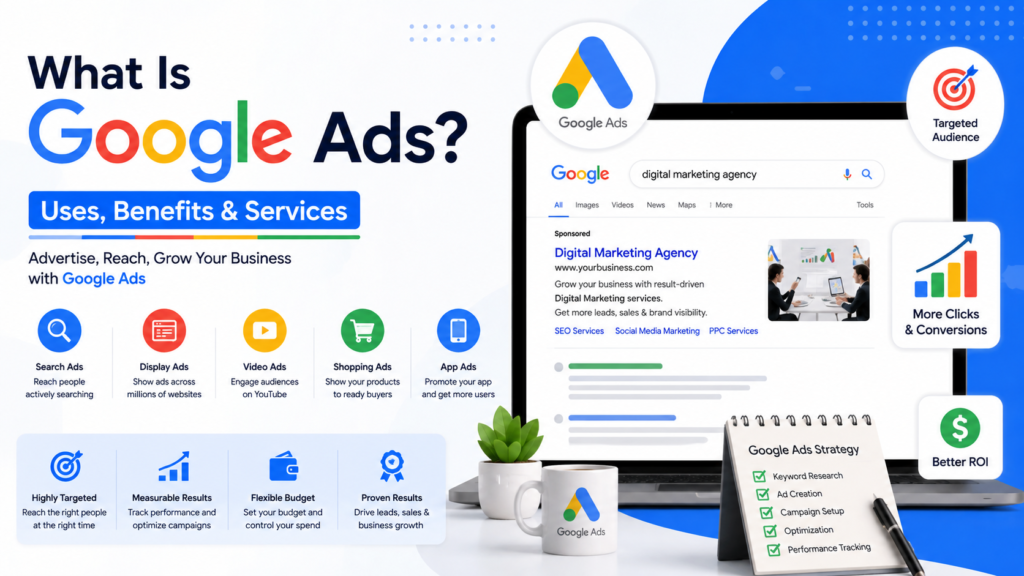
Table of Contents
If you have ever searched for something on Google and noticed sponsored results at the top of the page, you have already seen Google Ads in action. But what is Google Ads, and why do businesses use it?
Google Ads is an online advertising platform that allows businesses to promote their products and services across Google. Businesses can create advertisements that reach people based on what they search for, their interests, location, and other relevant signals.
Unlike traditional advertising, Google Ads can help businesses reach potential customers when they are actively looking for information, products, or services. Therefore, it can be a valuable part of a digital marketing strategy.
In this guide, you will learn how Google Ads works, its major benefits, different campaign types, and the uses of Google Ads services for businesses.
What Is Google Ads?
Google Ads is Google’s online advertising platform. It allows businesses to create paid campaigns to promote their products, services, websites, apps, or other online assets.
For example, imagine someone searches for “best digital marketing agency near me.” A relevant business can create an advertisement that may appear when people search for related terms.
The advertiser typically sets a budget, chooses targeting options, creates ad content, and monitors campaign performance.
Google Ads can therefore connect businesses with people who may already have an interest in what they offer.
How Does Google Ads Work?
The process starts with choosing an advertising goal. Depending on the campaign, the goal might be website traffic, leads, sales, app promotion, or brand awareness.
Next, the advertiser selects campaign settings and creates the required ads.
Google then uses its advertising systems to determine which ads are eligible to appear for relevant searches or placements. Factors such as bid, ad quality, relevance, and other signals can influence ad delivery.
Therefore, successful advertising is not simply about spending more money. Relevance and campaign quality also matter.
Why Do Businesses Use Google Ads?
Google Ads can provide businesses with a direct way to reach potential customers online. However, its value depends on how well campaigns are planned and managed.
1. Reaches People With Purchase Intent
One major advantage is search intent.
When someone searches for a product or service, they may already be considering a purchase. Therefore, showing a relevant advertisement at the right moment can help a business capture that demand.
For example, someone searching for “website design services” may be more likely to contact a web design company than someone casually browsing general content.
2. Provides Measurable Results
Digital advertising provides detailed performance information.
Businesses can monitor metrics such as clicks, impressions, conversions, cost, and conversion value. Consequently, marketers can identify which campaigns perform well and which areas need improvement.
Google provides official documentation explaining how advertisers can measure conversions and evaluate campaign performance. Google Ads Help
3. Supports Different Marketing Goals
Google Ads is not limited to one type of campaign.
Businesses can use different campaign formats depending on their objectives. For instance, a company may want to generate leads, increase online sales, promote an app, or build awareness.
As a result, businesses can create campaigns that match different stages of the customer journey.
4. Offers Flexible Budget Control
Advertisers can set budgets and adjust campaign settings based on their business requirements.
This flexibility can be useful for both small businesses and larger organizations. However, a small budget does not guarantee low costs or strong results. Campaign targeting and relevance still matter.
5. Helps Businesses Test Marketing Ideas
Google Ads can also be useful for testing.
A business can experiment with different keywords, ad messages, landing pages, and audiences. Then, it can compare performance and use the findings to improve future campaigns.
What Are the Main Types of Google Ads Campaigns?
Google offers several campaign types. The best option depends on the business objective.
Search Campaigns
Search campaigns can show text advertisements when users search for relevant terms on Google.
They are particularly useful when customers are actively looking for products or services.
For example, a local company might target searches related to its services and location.
Display Campaigns
Display advertising can help businesses reach audiences across websites and other digital placements within Google’s advertising network.
These campaigns can be useful for visual advertising, awareness, and remarketing strategies.
Shopping Campaigns
Shopping campaigns are designed for businesses that sell products online.
They can showcase product information, such as product images, names, and prices, to people searching for products.
Therefore, they can be especially useful for e-commerce businesses.
Video Campaigns
Video campaigns allow advertisers to promote content through Google’s video advertising ecosystem, including YouTube.
Businesses can use video to demonstrate products, explain services, tell stories, or build awareness.
App Campaigns
App campaigns can help businesses promote mobile applications.
They can be used to encourage people to install or engage with an app.
Performance Max Campaigns
Performance Max campaigns allow advertisers to access multiple Google advertising channels through a single campaign.
According to Google, Performance Max is designed to help advertisers achieve conversion goals across Google’s advertising inventory.
Businesses should choose campaign types based on their goals rather than selecting a format simply because it is popular.
What Are the Uses of Google Ads Services?
The phrase whats the uses of google Ads services can be understood as asking how professional Google Ads services can help a business.
Google Ads services may involve planning, campaign creation, optimization, monitoring, and reporting.
Keyword Research
Professionals can research relevant search terms that potential customers may use.
The goal is to identify opportunities that match the business’s products or services while considering competition and commercial intent.
Campaign Setup
A Google Ads professional can help configure campaigns, ad groups, targeting, budgets, conversion tracking, and other settings.
Proper setup is important because mistakes at the beginning can affect campaign performance.
Ad Creation
Ad copy needs to be relevant and useful.
Professionals can create different headlines and descriptions that communicate a clear benefit and encourage users to take action.
Landing Page Optimization
Getting a click is only part of the process.
After clicking an advertisement, users should arrive on a relevant and easy-to-use landing page. Therefore, businesses should make sure the page clearly explains the offer and provides a simple next step.
Campaign Monitoring
Google Ads campaigns should not simply be launched and forgotten.
Regular monitoring can reveal changes in costs, clicks, conversions, and other performance indicators. Consequently, campaigns can be adjusted based on actual results.
Conversion Tracking
Conversion tracking helps businesses understand whether advertising leads to valuable actions.
These actions may include:
- Form submissions
- Phone calls
- Purchases
- App installations
- Bookings
- Sign-ups
- Other business goals
Without proper measurement, it can be difficult to determine whether advertising investment is producing meaningful results.
How to Create a Google Ads Strategy
A successful campaign begins with a clear strategy.
Step 1: Define Your Goal
First, decide what you want the campaign to achieve.
For example, your goal could be:
- Generate leads
- Increase sales
- Get phone calls
- Increase website traffic
- Promote an app
- Build brand awareness
A clear objective makes campaign decisions easier.
Step 2: Understand Your Audience
Next, identify your ideal customer.
Consider what they need, what problems they have, what they search for, and what action you want them to take.
The better you understand the audience, the easier it becomes to create relevant advertisements.
Step 3: Choose Relevant Keywords
For search campaigns, keyword selection is important.
Focus on terms that closely match your products or services. At the same time, consider search intent.
For example, “digital marketing agency” may indicate stronger commercial intent than a general search such as “digital marketing meaning.”
Step 4: Write Relevant Ads
Your advertisements should clearly communicate what you offer.
Use concise language and highlight a useful benefit. Furthermore, make sure the message matches the landing page.
Step 5: Optimize the Landing Page
The landing page should provide a smooth experience.
It should load properly, work well on mobile devices, explain the offer clearly, and make the desired action easy to complete.
Step 6: Track and Improve
Finally, monitor campaign results.
If a campaign receives many clicks but few conversions, the landing page, targeting, offer, or ad message may need attention.
Similarly, if one campaign consistently generates valuable conversions, you can investigate what makes it successful and apply those insights elsewhere.
Common Google Ads Mistakes to Avoid
Google Ads can produce strong results, but poor setup can waste advertising budget.
Targeting Too Broadly
Broad targeting can bring irrelevant traffic. Therefore, make sure your audience and campaign settings match your business goals.
Ignoring Search Intent
Not every keyword has the same meaning.
A user looking for information may not be ready to buy. Consequently, understand the intent behind searches before investing heavily in them.
Sending Everyone to the Same Page
A generic homepage may not be the best destination for every advertisement.
Instead, send users to a page that directly relates to the advertisement and their search.
Not Tracking Conversions
Without conversion tracking, you may focus on clicks instead of business results.
Therefore, set up appropriate measurement before judging campaign success.
Failing to Review Campaigns
Advertising performance can change over time.
As a result, review campaigns regularly and make data-based improvements.
Google Ads vs. SEO
Google Ads and SEO both help businesses gain visibility in search engines. However, they work differently.
Google Ads involves paid advertising. SEO focuses on improving organic visibility through content, technical optimization, website quality, and other factors.
Paid advertising can provide visibility quickly after a campaign becomes eligible to serve. On the other hand, SEO generally requires longer-term effort.
Therefore, businesses do not always need to choose one over the other. A combined strategy can use paid advertising for immediate opportunities while building organic visibility for long-term growth.
If you are working on your website’s organic visibility, you can also read our guide on [how to do SEO for my website].
How Much Should You Spend on Google Ads?
There is no single budget that works for every business.
Your advertising budget can depend on your industry, location, competition, customer value, campaign objective, and available resources.
For example, a business selling a high-value service may be able to justify a higher cost per lead than a business selling a low-cost product.
Therefore, start with a realistic budget and use campaign data to understand performance. As results become clearer, you can adjust spending based on your goals.
Add links to relevant articles already published on your website. For example:
- How to do SEO for my website → link to your SEO guide.
- What is social media marketing? → link to your social media marketing article.
- What is affiliate marketing? → link to your affiliate marketing guide.
- YouTube monetization guide → link to your YouTube-related article.
Final Thoughts
So, what is Google Ads? It is Google’s online advertising platform that helps businesses promote products and services to relevant audiences across Google’s advertising channels.
Businesses can use it to generate leads, increase sales, drive website traffic, promote apps, and build awareness. Moreover, professional Google Ads services can help with keyword research, campaign setup, ad creation, conversion tracking, optimization, and reporting.
However, successful advertising is not simply about increasing your budget. A strong strategy requires relevant targeting, useful advertisements, appropriate landing pages, accurate measurement, and continuous optimization.
Start with a clear goal. Then understand your audience, choose the right campaign type, measure meaningful results, and improve your campaigns based on data.
When managed carefully, Google Ads can become a valuable part of a broader digital marketing strategy.
One response to “What Is Google Ads? Complete Beginner’s Guide”
[…] What Is Google Ads? Complete Beginner’s Guide […]