YouTube New Policy for Monetization Explained
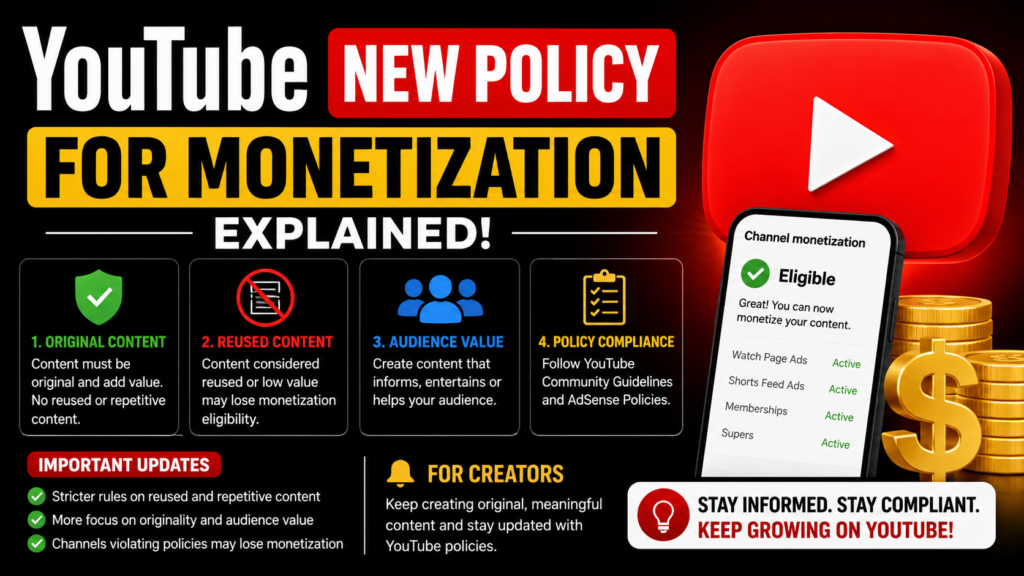
Table of Contents
On July 15, 2025, YouTube updated its monetization guidelines to clarify that repetitive or mass-produced content may be considered inauthentic content.
However, this change did not introduce a completely new monetization system. Instead, YouTube renamed and clarified its existing policy so creators could better understand which types of content may not qualify for monetization.
For monetized content, YouTube expects creators to provide original and authentic value. This value can come through education, entertainment, commentary, storytelling, analysis, or other meaningful contributions.
Importantly, YouTube may evaluate the overall quality and originality of a channel rather than looking at only one video. Therefore, creators should consider the quality of their entire content library.
Reviewers may consider factors such as:
The channel’s main topic
Most-viewed videos
Newest videos
Videos responsible for the largest share of watch time
Video titles and descriptions
Thumbnails
The channel’s About section
As a result, creators should think about their entire content library when following the YouTube new policy for monetization.
What Is Inauthentic Content Under YouTube’s Monetization Policy?
Inauthentic content generally refers to videos that are mass-produced, repetitive, or created using templates with little meaningful variation or value.
For example, imagine a channel uploading hundreds of videos that use almost the same script, voice, images, storyline, and editing style while changing only a few words.
Although each upload may technically be a different video, the overall channel could still appear repetitive and mass-produced.
In other words, YouTube’s main concern is whether viewers receive meaningful value from the content.
Which Content May Not Qualify for YouTube Monetization?
For instance, examples of content that may create monetization problems include:
Mass-produced videos using nearly identical templates
Repetitive videos with minimal educational or entertainment value
Image slideshows with little or no narration
Scrolling text with minimal commentary
Videos that simply read material created by someone else
Automatically generated videos with little original input
Multiple videos with nearly identical scripts and storylines
However, the important factor is not simply whether a video was created using automation or AI.
Instead, the bigger question is whether the finished content provides original, meaningful, and valuable information or entertainment.
Does the YouTube New Policy for Monetization Ban AI Videos?
No. AI-generated content is not automatically banned from YouTube monetization.
In fact, this is one of the biggest misconceptions about the policy.
Creators can use artificial intelligence as part of their production process. For example, AI can help with:
Brainstorming video ideas
Research assistance
Script development
Voice generation
Video editing
Graphic creation
Captions and subtitles
Improving production workflows
However, using AI does not automatically make content original.
The risk occurs when creators use AI to produce large numbers of nearly identical videos with little human creativity, commentary, storytelling, or educational value.
Therefore, creators should focus on the quality and originality of the finished content rather than simply asking whether AI was used.
Can AI-Generated Content Be Monetized on YouTube?
Yes, AI-assisted or AI-generated content can potentially be monetized when it follows YouTube’s monetization requirements and provides meaningful value.
For instance, a creator might use AI to research a topic, generate initial ideas, or assist with editing. After that, the creator can add:
Original research
Personal insights
Unique examples
Human commentary
Original storytelling
Meaningful editing
Educational explanations
As a result, the final product can provide significantly more value than simply publishing automatically generated videos at scale.
Ultimately, the safest approach is to use AI as a creative and productivity tool, rather than treating it as an automated content factory.
How Does YouTube’s Reused Content Policy Affect Monetization?
Similarly, the July 2025 update did not change YouTube’s reused content policy.
Reused content generally involves material originally created elsewhere that is republished without enough original commentary, modification, or additional value.
However, reused material can still be eligible for monetization when a creator significantly transforms it.
For example, creators may use external material as part of:
Critical reviews
Reaction videos with meaningful commentary
Educational explanations
Sports analysis
Edited clips with a new storyline
Film or television commentary
Videos that add substantial educational or entertainment value
What Counts as Transformative Reused Content?
The key factor, therefore, is the original value added by the creator.
For example, simply downloading someone else’s video and uploading it to your channel does not make it original.
On the other hand, using a short clip while providing your own analysis, explanation, criticism, or educational context can create a substantially different viewing experience.
Therefore, creators should focus on transformation, commentary, and added value when using third-party material.
Can Faceless Channels Qualify Under the YouTube Monetization Policy?
Yes.
Fortunately, YouTube does not require creators to appear on camera to qualify for monetization.
A faceless channel can be monetized when its content is original, useful, entertaining, educational, or otherwise valuable to viewers.
For example, faceless channels can create:
Educational tutorials
Original documentaries
Screen-recorded software guides
Financial education
Original storytelling
Animated educational videos
Product explainers
Commentary channels
How-to videos
However, a channel that simply combines stock images, an AI-generated voice, and automatically produced scripts across hundreds of similar videos may face monetization issues if the content is repetitive or lacks meaningful original value.
How Can Faceless Creators Stay Eligible for Monetization?
To begin with, faceless creators should focus on creating a recognizable and valuable content style.
In addition, consider adding:
Original scripts
Unique research
Personal analysis
Custom visuals
Meaningful narration
Original storytelling
Detailed explanations
Unique examples and case studies
In short, being faceless is not the problem. Instead, low-value and repetitive content is the bigger concern.
How Can Creators Follow the New YouTube Monetization Rules?
Creators can reduce monetization risks by focusing on originality, quality, and viewer value.
1. Add Original Commentary
First, if you use external footage, images, statistics, or other material, add your own perspective.
For example, explain why the information matters and include analysis, examples, opinions, comparisons, or educational context.
As a result, viewers receive something more valuable than the original material alone.
2. Make Each Video Meaningfully Different
Next, remember that using a consistent format is not necessarily a problem.
A channel can have a recognizable structure, intro, outro, or visual style while still producing original content.
Instead, the important thing is that the main substance of each video is meaningfully different.
For instance, a marketing channel might use the same presentation style for every video while covering different strategies, case studies, examples, and insights.
3. Avoid Mass-Produced Content
Furthermore, publishing a large number of videos is not automatically against the rules.
The concern is producing large quantities of content that are almost identical.
Therefore, instead of creating 100 videos with nearly the same script and structure, focus on different:
Topics
Examples
Stories
Research
Perspectives
Explanations
Visual presentations
In this way, your channel can maintain a consistent style while still providing genuinely different value in each video.
4. Use AI as a Creative Tool
Moreover, AI can help creators work more efficiently, but it should not replace meaningful creative input.
For example, you can use AI for research assistance and brainstorming before developing your own script, examples, editing, and presentation.
As a result, this approach can help maintain a healthy balance between production efficiency and originality.
5. Review Your Existing YouTube Content
Finally, don’t focus only on your newest videos.
If your channel already contains a large number of repetitive uploads, review your older content as well.
In particular, look for videos that:
Provide very little original value
Repeat the same information
Use almost identical templates
Rely heavily on copied material
Contain minimal commentary
Are substantially similar to other videos on your channel
Consequently, improving the overall quality of your channel can be more valuable than simply changing your latest upload.
What Are the YouTube Monetization Requirements?
Following the inauthentic-content policy is only one part of becoming eligible for monetization.
In addition, creators must follow YouTube’s broader requirements and policies, including:
YouTube Partner Program requirements
Community Guidelines
Copyright policies
Advertiser-friendly content guidelines
Applicable monetization policies
Commercial rights for content used in videos
Therefore, having original videos does not automatically guarantee monetization.
Creators should also make sure they have the necessary rights to use music, footage, images, graphics, and other third-party materials.
Is the New YouTube Monetization Policy Bad for Creators?
Not necessarily.
Instead, the clarification may actually benefit creators who consistently produce original and useful content.
Overall, the direction is to prevent channels from generating large quantities of low-value, repetitive content while rewarding content that viewers find useful, educational, entertaining, or interesting.
For serious creators, the message is relatively simple:
Create less generic content and more valuable content.
Instead of asking, “How many videos can I publish?”, creators should also ask:
“What unique value does my video provide to the viewer?”
Ultimately, that mindset can help creators build stronger channels over the long term.
Final Thoughts on the YouTube New Policy for Monetization
Overall, the YouTube new policy for monetization is best understood as a clarification rather than a complete overhaul of YouTube’s monetization system.
The July 2025 update renamed the former “repetitious content” policy as “inauthentic content” and clarified that repetitive and mass-produced content can be ineligible for monetization.
At the same time, AI tools are not automatically prohibited. Faceless channels are not automatically prohibited either. Similarly, reused content can qualify when creators add significant original commentary, transformation, education, or entertainment value.
Therefore, the safest strategy is to build your channel around:
Original ideas
Useful information
Meaningful commentary
Authentic storytelling
High-quality production
Distinctive videos
If you use AI, use it to enhance your creativity—not replace it.
Ultimately, YouTube monetization is less about whether you use AI, automation, stock footage, or a faceless format. Instead, it is more about the value and originality of the content you publish.
Want to grow your YouTube channel and turn your content into a real income source?
Start by understanding the complete YouTube Monetization Guide, and then use these policy updates to create content that is original, valuable, and built for long-term growth.
In addition, read our complete YouTube Monetization Guide to learn about eligibility, monetization requirements, content policies, and practical strategies for creators.
Create original content. Stay consistent. Build a channel that lasts.