7 Powerful Email Marketing Strategies to Increase Sales
Introduction
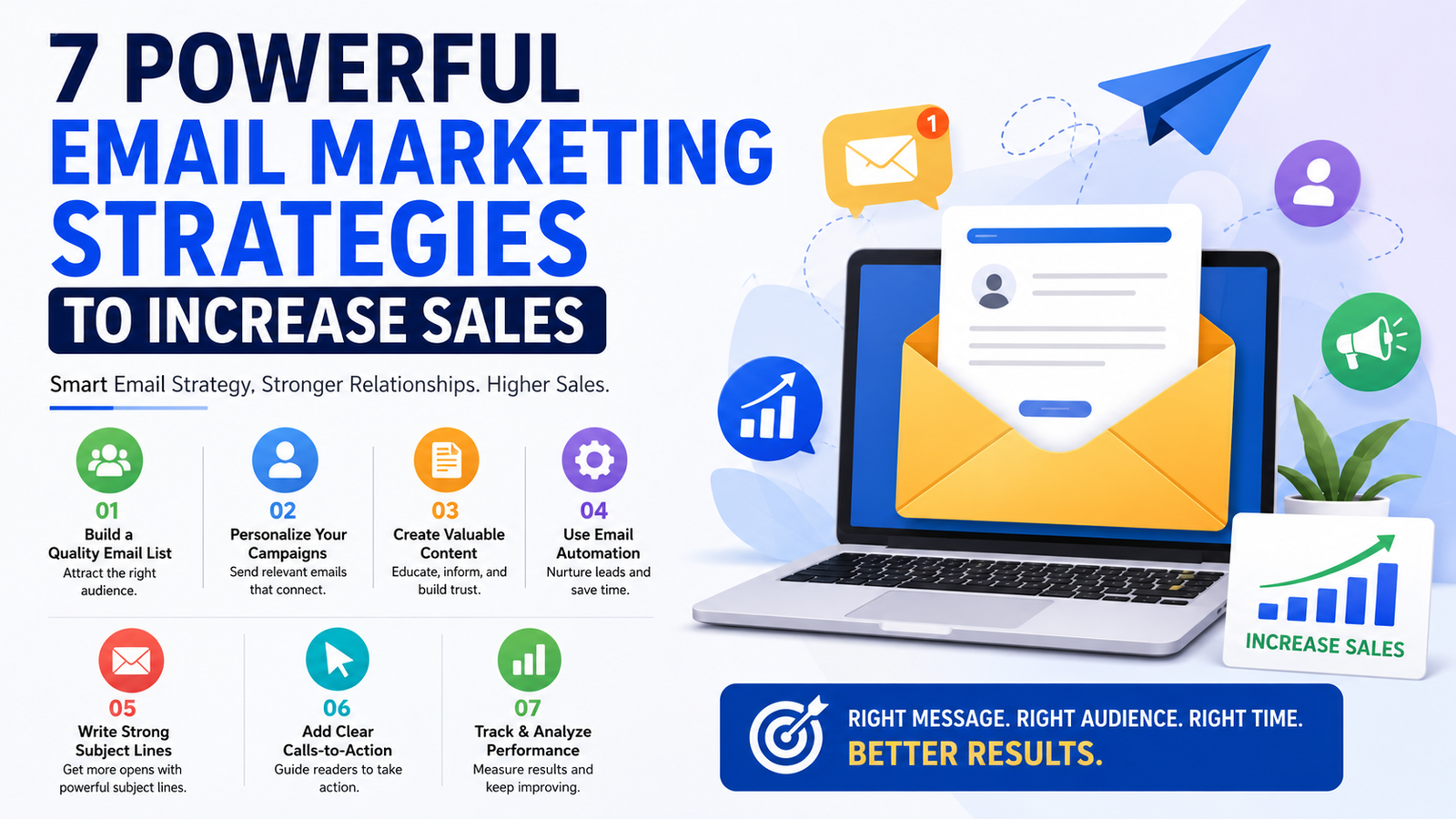
Email marketing is still one of the most effective ways for businesses to connect with customers, build relationships, and increase sales.
People check their emails every day, which makes email a valuable channel for businesses that want to stay connected with their audience. But simply sending emails is not enough. If your emails are not relevant, useful, or interesting, people may ignore them or unsubscribe.
This is where a strong email marketing strategy makes a difference.
From building the right email list to creating personalized campaigns and using automation, businesses can use email marketing to move potential customers from interest to purchase.
Whether you are a small business, startup, e-commerce brand, or digital marketing professional, understanding how to use email marketing to increase sales can help you generate more leads and build long-term customer relationships.
In this blog, we will explore 7 powerful email marketing strategies that can help you improve engagement, generate leads, and increase conversions.
Summary
Successful email marketing is not about sending promotional emails every day.
It is about sending the right message to the right person at the right time.
A strong email marketing campaign should focus on:
- Building a quality email list
- Understanding your audience
- Personalizing emails
- Creating valuable content
- Using email automation
- Writing strong subject lines
- Tracking and improving campaign performance
When these strategies work together, email can become more than a communication channel.
It can become a powerful tool for lead generation, customer retention, and sales growth.
1. Build a Quality Email List
The foundation of successful email marketing is a quality email list.
You may have thousands of email addresses, but if those people are not interested in your business, your campaigns will not generate good results.
Instead of focusing only on the size of your email list, focus on the quality of your subscribers.
You can build an email list through:
- Website signup forms
- Free guides and ebooks
- Newsletters
- Discounts and offers
- Webinars
- Free consultations
- Lead magnets
- Social media campaigns
- Landing pages
For example, a digital marketing institute can offer a free “SEO Beginner’s Guide” in exchange for an email address.
Someone who downloads the guide is already interested in SEO or digital marketing. This makes them a more relevant lead than someone who simply joined a random mailing list.
Always collect email addresses with permission and give subscribers a clear reason to join.
A quality email list can help improve engagement, deliverability, and conversions.
2. Personalize Your Email Marketing Campaigns
People are more likely to pay attention to emails that feel relevant to them.
Instead of sending exactly the same email to everyone, use email personalization whenever possible.
You can personalize emails using information such as:
- Name
- Location
- Previous purchases
- Interests
- Website activity
- Course interest
- Previous email engagement
For example, instead of sending:
“Check out our new digital marketing course.”
you could send:
“Ready to improve your SEO skills, Rahul?”
A personalized message feels more relevant.
But personalization is more than adding someone’s name.
You can also personalize the content, offer, timing, and recommendations based on the customer’s interests.
For example, someone who downloaded an SEO guide could receive emails about SEO training, while someone interested in social media marketing could receive content related to social media courses.
This makes your email marketing strategy more targeted and useful.
3. Create Valuable Content, Not Just Promotional Emails
One of the most common email marketing mistakes is making every email a sales pitch.
If every message asks people to:
“Buy Now”
or
“Enroll Today”
subscribers may stop paying attention.
Instead, provide value before asking for a sale.
Your email content can include:
- Helpful tips
- Guides
- Tutorials
- Industry updates
- Case studies
- Free resources
- Customer stories
- Product updates
- Special offers
For example, a digital marketing institute could create an email sequence like:
Email 1: 5 SEO Mistakes Beginners Should Avoid
Email 2: How to Find the Right Keywords
Email 3: How AI Is Changing SEO
Email 4: Free SEO Checklist
Email 5: Explore Our Digital Marketing Course
This approach helps build trust with your audience before promoting a product or service.
The more value you provide, the more likely subscribers are to continue engaging with your emails.
4. Use Email Automation to Convert Leads
Email automation can make your marketing strategy more efficient.
Instead of manually sending every email, you can create automated email sequences that are triggered by specific actions.
For example:
Website visitor → Downloads a guide → Receives welcome email → Gets useful tips → Receives a relevant offer
This is known as an email marketing automation funnel.
Common types of automated email campaigns include:
- Welcome emails
- Lead nurturing emails
- Abandoned cart emails
- Follow-up emails
- Product recommendation emails
- Re-engagement emails
- Post-purchase emails
- Promotional campaigns
For example, imagine someone downloads a Digital Marketing Career Guide from your website.
You could create an automated sequence:
Day 1: Welcome email + free guide
Day 3: Digital marketing career tips
Day 5: Important digital marketing skills
Day 7: SEO and AI marketing guide
Day 10: Digital marketing course information
This allows you to stay connected with potential customers without manually sending every message.
Effective email marketing automation can save time while helping businesses nurture leads and increase conversions.
5. Write Strong Email Subject Lines
Your email may contain excellent content, but if people do not open it, it cannot generate results.
That is why your email subject line is so important.
A good subject line should give the reader a reason to open the email.
For example, instead of:
“Our New Course”
try:
“Want to Learn Digital Marketing in 2026?”
Instead of:
“SEO Tips”
try:
“7 SEO Mistakes That Could Hurt Your Rankings”
You can improve your subject lines by:
- Asking a question
- Highlighting a benefit
- Creating curiosity
- Offering useful information
- Using personalization
- Creating genuine urgency
However, avoid misleading clickbait.
If your subject line promises something that the email does not deliver, you can lose the reader’s trust.
The best email subject line is one that is relevant to your audience and clearly communicates the value of opening the email.
6. Add Clear Calls-to-Action
Every marketing email should have a clear purpose.
Ask yourself:
What do I want the reader to do after reading this email?
Your CTA could be:
- Learn More
- Download Now
- Book a Free Consultation
- Start Your Free Trial
- View Course
- Shop Now
- Enroll Today
- Contact Us
For example, if your goal is to generate course enrollments, your CTA could be:
“Explore the Digital Marketing Course”
If your goal is lead generation:
“Book Your Free Consultation”
Avoid confusing readers with too many competing calls-to-action.
A strong email marketing campaign should connect the email with a relevant landing page.
For example:
Email → Offer → Landing Page → Action
This creates a smoother customer journey and makes it easier for users to take the next step.
7. Track Your Email Marketing Performance
You cannot improve your email marketing strategy if you do not measure its performance.
Important email marketing metrics include:
- Open rate
- Click-through rate
- Conversion rate
- Bounce rate
- Unsubscribe rate
- Delivery rate
- Revenue generated
- Subscriber growth
For example, if your email has a high open rate but a low click-through rate, your subject line may be working well, but your email content or CTA may need improvement.
If your click-through rate is high but conversions are low, you may need to improve your landing page or offer.
Tracking these metrics helps you understand what is working and what needs improvement.
You can test different:
- Subject lines
- CTAs
- Email formats
- Offers
- Content
- Sending times
- Audience segments
This process helps you continuously improve your email marketing campaigns.
How Email Marketing Can Increase Sales
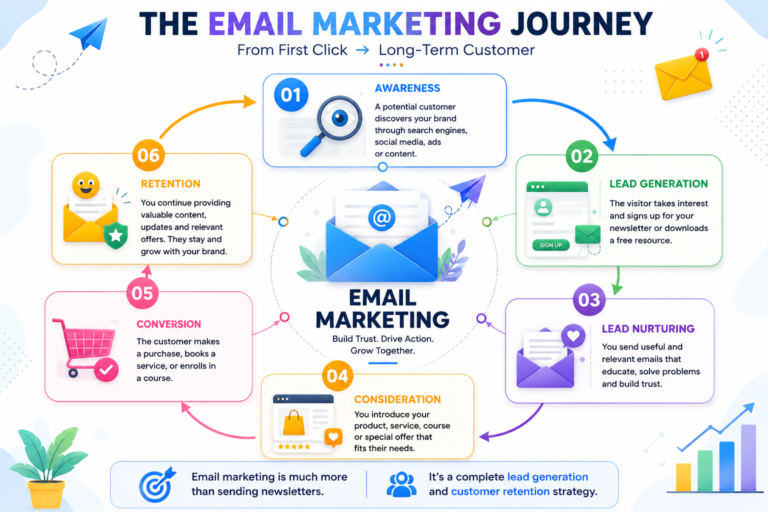
Email marketing can support customers throughout their buying journey.
Awareness
A potential customer discovers your brand through search engines, social media, advertisements, or content.
↓
Lead Generation
The visitor signs up for your newsletter or downloads a free resource.
↓
Lead Nurturing
You send useful and relevant emails that educate the subscriber and build trust.
↓
Consideration
You introduce your product, service, course, or special offer.
↓
Conversion
The customer makes a purchase, books a service, or enrolls in a course.
↓
Retention
You continue providing useful content, updates, and relevant offers.
This is why email marketing is much more than sending newsletters.
It can become a complete lead generation and customer retention strategy.
Email Marketing for Small Businesses
Email marketing can also be highly useful for small businesses.
You do not need a huge marketing budget to get started.
A simple email marketing strategy can include:
- Create a useful lead magnet.
- Add a signup form to your website.
- Build your subscriber list.
- Send valuable content regularly.
- Segment your audience.
- Create an automated welcome sequence.
- Promote relevant products or services.
- Track your results.
For example, a local digital marketing institute can attract potential students through a free SEO webinar.
After registration, the institute can send educational emails about SEO, digital marketing careers, industry trends, and relevant courses.
This helps move potential students from interest to consideration to enrollment.
Common Email Marketing Mistakes to Avoid
Even a good email marketing strategy can fail when basic mistakes are repeated.
Avoid:
- Buying email lists
- Sending too many promotional emails
- Using misleading subject lines
- Sending irrelevant content
- Writing emails without a clear purpose
- Using unclear CTAs
- Ignoring mobile users
- Ignoring campaign analytics
- Sending emails without permission
- Making it difficult to unsubscribe
Successful email marketing is built on trust, relevance, and consistency.
Your subscribers should feel that your emails are useful rather than annoying.
Conclusion
Email marketing remains a powerful digital marketing strategy for businesses that want to generate leads, build relationships, and increase sales.
But successful email marketing is not about sending more emails.
It is about sending better and more relevant emails.
Build a quality email list.
Understand your audience.
Personalize your campaigns.
Create valuable content.
Use email automation to nurture leads.
Write strong subject lines.
Add clear calls-to-action.
And track your results regularly.
When these strategies work together, email marketing can become an important part of your overall digital marketing strategy.
The key is simple:
Right Audience + Right Message + Right Timing = Better Email Marketing Results
Learn Digital Marketing With Vidya Sarthi
Want to learn email marketing, SEO, Google Ads, social media marketing, content marketing, AI marketing, and other digital marketing skills?
Vidya Sarthi is a digital marketing institute where you can learn practical digital marketing skills and understand how modern marketing strategies can help businesses generate leads and increase sales.
Learn how to create email marketing campaigns, generate leads, build marketing funnels, use automation, and apply digital marketing strategies in real-world situations.
Join Vidya Sarthi and take the next step toward building your digital marketing career.